Keep looking!

Strange, isn’t it: We have more, much more to do than before Corona. We realized all books planned, even 3 additional titles. Everything has changed, all that has been learned in 27 years of publishing is totally new each day.—Are we prepared to the New? And wasn’t it exactly the New, the curiosity about »News« that inspired the founding of a… MORE


Authors & Books
Kurt Drawert
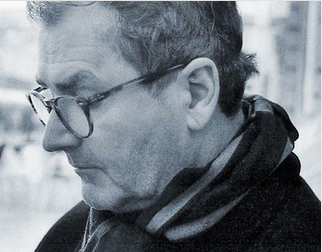
Born 1956 in Hennigsdorf (Brandenburg), childhood in Borgsdorf and Hohen-Neuendorf (near Berlin). 1967 Moved to Dresden, trained as a skilled worker in electronics. 1980 A-levels at night school, then unskilled work, including in a bakery and at the post office. Worked in the »Sächsische Landesbibliothek«, Dresden, then in a youth club. From 1982 to 1985 studies at the Institute for Literature, Leipzig. Moved to Leipzig in 1984.
Freelance author since 1986. Married the photographer Ute Döring in 1991. 1993 Moves to Osterholz-Scharmbeck (near Bremen), 1995/1996 stays at the Villa Massimo, Rome. 1996 move to Darmstadt.
2 children—Lars Drawert and Tilman Döring.
Since 1998 director of the Darmstadt Text Workshop. Since 2004 director of »Zentrum Junge Literatur«, Darmstadt. Since 2014 member of the German Academy for Language and Poetry. Since 2018 member of the Saxon Academy of Arts.
Viewing the multitude of his publications in detail on Kurt Drawert’s website is always worthwhile.
In my publishing programme, Kurt Drawert is first and foremost the editor of the Edition Darmstädter Textwerkstatt—it is a pleasure to have Kurt Drawert, his debutants and the edition in the publishing house!

To The East And The End of The World. & America Metaphors. (Nach Osten ans Ende der Welt. & America Metaphern.)
2 Stories / Essays
- Hardcover
- With bookmark
- 104 pages
978-3-86638-075-2

o mark his 70th birthday in March 2026, we will be publishing two volumes by Kurt Drawert; at the same time, Kurt Drawert will be publishing the third volume of his »Edition Darmstädter Textwerkstatt« with our publishing house.
The prose volume is considered the highlight among these three publications:
»Nach Osten ans Ende der Welt« (»To the East and the End of the World«) is »A Journey on the Trans-Siberian Railway« , as the subtitle tells us. It was published by Arche and Suhrkamp in 2002, but has long been out of print. The second prose work in the volume, »America Metaphern« (»America Metaphors«), was written during Kurt Drawert’s scholarship at Villa Aurora in Los Angeles in 2021 – the two texts subtly link the two former blocs of world politics, and beyond the follies of the once exclusive world powers, we recognize a European culture as a tertium datur. And even if it is only in the narrator’s view, as the drawer always understands how to capture forms and deformations of life from the broadest perspective.
»There is probably no journey in the world that requires more explanation than traveling almost 10,000 kilometers by train to the end of Russia and spending more than seven days in a two-by-two-meter cabin, mainly in bed [...] The voluntary waste of time, the pure tourist desire to book a grueling journey as a vacation—that is what is so elusive and almost incomprehensible to a local. Whoever you ask about their motives, you will be met with silence.«
– a verdict that Kurt Drawert immediately refutes: by brilliantly recounting, in anecdotal and analytical detail, what it means to be confined to the cramped space of the cabin while simultaneously experiencing the vastness of another culture – and, no less, one’s so-called »own«.
What awaits travelers in the completely different North American wilderness sounds strangely familiar. It is as if the cultures of great distances, under the premise of unimpeded accessibility in both Eastern and Western model cultures, have led to very similar constitutions.
However, Kurt Drawert has given his American travelogue—which, like the Trans-Siberian journey, is always close to being an essay—a different, more concise rhythm, thereby comparing the historic Russian rail train with the even more modern automobile orientation with its diners, gas stations, motels, and highways. So let’s take a look at how we drive through our lives.

The Opposite of Nothing. (Das Gegenteil von gar nichts.)
The Plays. (Die Stücke.)
- flap brochure
- 364 pages
- 4 plays and 2 essays
978-3-86638-076-9
Kurt Drawert can be described as one of the most versatile and prolific German-language authors. It is therefore wonderful to finally be able to compile his work as a playwright in a single volume.
»The opposite of nothing« is the title of one of his four plays. This overall title symbolizes what all his plays and their characters convey to us on stage: a Flaubertian longing for everything, accompanied by a torturous standstill of Beckettian proportions. Premiered at the Staatstheater Darmstadt and at the Stückemarkt Berlin between 1996 and 2009, these dramas, with the possible exception of »Monsieur Bovary / Theaterstück nach Flaubert« (Monsieur Bovary / Play based on Flaubert), are best described as comedies.
With the seven-scene play entitled »Everything is Simple.«, we are allowed to laugh at our ambitions even before the curtain rises; »Stone Age. Comedy.« confronts us with the timeless antiquity of our flights of fancy and fantasies. As an afterword—or rather as a fifth theater text—Kurt Drawert's essay »Das Theater am Ende seiner Selbstaufgeklärtheit« (Theater at the End of Its Self-Enlightenment) is included, which first appeared in his ambivalent volume »Rückseiten der Herrlichkeit« (The Backside of Glory). Based on Kusturica’s film »Underground«, the stage—like the screen—is recognized here as the surface on which our hypertrophies stumble, while in the depths of oblivion and repression, parallel worlds redeem their reality.
Theater critic Thomas Irmer contributed the essay »End- und Denkspiele« (End Games and Mind Games) about Kurt Drawert’s plays.
Michael Braun in his contribution »In Rufweite zum Schweigen« (Within Hailing Distance of Silence) from the Text+Kritik volume:
As far as I can see, Drawert is the only German author of standing who, with great determination and conceptual consistency, not only builds on the insights of the French master thinkers Lacan, Foucault, Deleuze, and Barthes, but also translates them epistemologically into a rigorous aesthetic theory... Drawert seeks to break away from the superficialities of the literary world and the emptiness of media discourse by analyzing the cultural symptoms of exhaustion in all their unbearable intensity, right down to their microstructures.
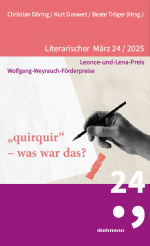
»quir quir« – what was that? (»quir quir« – was war das?)
The Anthology of Nominees And Winners of The Leonce-and-Lena-Prize (Die Anthologie der Nominierten und Preisträger des Leonce-un
- 176 pages
- Softcover
- With a greeting by the mayor
- of the science city of Darmstadt, Hanno Benz,
- and a preface by Christian Döring,
- as well as information
- about the editors and jurors
978-3-86638-466-8
The jury—consisting of Frieder von Ammon, Yevgeniy Breyger, Dagmara Kraus, Nadja Küchenmeister and Alexander Schnickmann, winner of the previous competition in 2023—has awarded Sandra Burkhardt the 2025 Leonce and Lena Prize for a large-scale text.
The sponsorship prizes named after the poet Wolfgang Weyrauch go to Ana Tcheishvili and Ozan Zakariya Keskinkılıç.
Congratulations to all three of them—and we also wish the seven nominees the best of luck in their future poetic endeavors. It is wonderful to have them all in our anthology for the award, with a total of around 100 poems.
The judges wrote in their statement: »Only when everything has been laid bare can the self enter the world. A self that repeatedly revisits two thousand years of tradition in order to build itself up, to bridge a gap, pointed arches, spray arches, two wings and a central nave – which continues in a fantastic interplay of lines and flows back into its abandoned center. The 2025 Leonce-and-Lena-Prize goes to Sandra Burkhardt for a poetological border crossing, for a spell and augur’s saying, for the wild and the sacred, grandiose erudition, sparkling humor, and the definitive answer to the question of what queer actually means. ‚The reading results are now in‘, and so the world is created, lustful, gothic, neo-neo-gothic.«
The winners:
Sandra Burkhardt (born in 1992 in Laupheim) studied art history and creative writing in Karlsruhe, Leipzig, and Berlin. In 2016, she was the winner of the poetry prize at the 24th Open Mike in Berlin. In 2018, her debut collection Wer A sagt (Whoever Says A) was published by Gutleut Verlag, in which she explores the phenomenon of ornamentation and which was featured in the poetry recommendations for the Leipzig Book Fair in 2019.In 2024, Fragments of a True Icon followed, featuring mistranslations of Francesco Petrarca’s love poems, published by kookbooks. Since 2020, she has been a member of the German-Arabic literature and translation collective Wiese (as it is) مرج.
Ana Tcheishvili (born 1993) was born and raised in Tbilisi, Georgia. She studied psychology and liberal arts in Tbilisi, Berlin, and Leipzig. She writes mainly poetry in German and Georgian, publishes in German-language literary magazines and anthologies, and performs at readings, including at the 2024 Poetry Festival in Berlin. Her first collection of poems, Der Tote ist nicht von uns (The Dead Man Is Not One of Us), was published by Verlagshaus Berlin in fall 2024. She currently works as a psychologist and studies at the German Literature Institute in Leipzig.
Ozan Zakariya Keskinkılıç (born 1989) is a political scientist, freelance author, and poet. He studied political and social sciences in Vienna, Berlin, and Cambridge. In addition to academic texts and columns, he writes essays, radio plays, prose, and poetry. In August 2022, Keskinkılıç made his debut with the poetry collection Prinzenbad, published by Elif Verlag, for which he was nominated for the Clemens-Brentano-Prize and the Dresden Poetry Prize in 2024. His poems have been translated into English, Italian, Kazakh, and Czech. In 2023, he participated in the 26th Klagenfurt Literature Course and received a scholarship from the Lower Saxony Foundation in the SchreibZeit program "Poetry in the Digital Age." Keskinkılıç performs literary performances at various festivals and cultural events. His poems are presented in art exhibitions and museum interventions, including at the Grassi Museum in Leipzig, the Literaturpassage in Vienna, and most recently at the Künstlerhaus Bethanien in Berlin. Keskinkılıç’s second poetry collection will be published by Elif Verlag in spring 2026. Prinzenbad. Poems, Elif Verlag 2022.
But let's not forget the nominees, who are:
Johanna Carl
Leo Pinke
Liv Thastum
Lilith Tiefenbacher
Read Christian Döring’s preface and the table of contents HERE – stay curious!
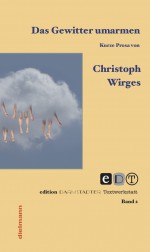
Embracing The Storm (Das Gewitter umarmen)
Short Prose
- Volume 2
- Edition Darmstädter Textwerkstatt (Darmstadt Text Workshop edition)
- Published by and with preface of
- Kurt Drawert
- 160 pages
- Hardcover
- With bookmark
978-3-86638-371-5
Volume 2 of the edition Darmstädter Textwerkstatt brings together short prose works by Christoph Wirges. In keeping with the concept of the edition, the volume is the first independent publication by the Mainz-based author. Most of the texts were written in Kurt Drawert’s Darmstadt Text Workshop, the editor of the series.
The first half of the volume presents laconic micro-stories in which we encounter bizarre male characters and revenants. In rapid succession, the overlapping images create an absurd cosmos of manhood and humanity. – The prose poems in the second part combine extreme condensation, flâneur-like reflection, and lyrical chronicle into a persistent tangle. They playfully confront the impositions of the contemporary world and develop a time-critical poetic of entanglement.
It is the attitude of the incidental, the comical, the somehow unconventional and slightly off-kilter that makes up the charm of these short (and truly shortest possible) stories, which are sometimes closer to poetry than to the epic sentence of prose. Nevertheless, despite the sometimes pointedly exaggerated situational comedy, there is a crack in the surface of the texts that reveals the abyss; it is the real, the absurd, the unpredictable, which can never be completely controlled and managed, no matter how much modern technologies claim to do just that: to create a transparent world, efficient in its processes and transparent in its mechanics. Subcutaneously, these little, to use Günter Eich’s word, »moles« of language undermine the prevailing order of a social grammar in which conditions are inscribed. The absurd is always an attack on the «zeitgeist« – Kurt Drawert in his preface.
Many thanks to Lisa Weber for the cover image.
The publisher, editor, and author would like to express their sincere gratitude to the Science City Darmstadt for its support!
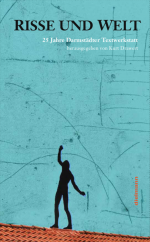
Cracks And World (Risse und Welt)
25 Texts From The Darmstadt Text Workshop (Darmstädter Textwerkstatt)
- Hardcover
- 312 pages with bookmark
- and numerous photographs,
- facsimiles, and illustrations
978-3-86638-380-7
Kurt Drawert has been running the Darmstädter Text Workshop for 25 years, which has produced over 200 authors to date. His achievements here are reflected in this volume—and can also be summarized, as he himself does in the preface, as follows:
Reading literary texts is always a work of interpretation and thus literary in itself. The reader meets the author halfway—namely, where the author departs from the unambiguity of his or her speech and must become metaphorical. What we read is therefore never identical to the author’s intention. A critically reflective group can reflect quite accurately how much the intention and effect of a text diverge, or to put it more simply: how understandable (in the sense of complex literary understanding) it is. The prerequisite for this is their emotional competence, freedom from aggression and competitive pressure, and the ability to offer a safe space for discussion. For me, as the workshop leader, this means moderating a group with the utmost sensitivity so that it can achieve this on its own. Paying attention to these connections, through which literature is also influenced from outside during its creation, by its ability to relate and its quality of contact, is perhaps what makes our workshop so special. Discovering literary talent is only the beginning; developing it and establishing it editorially is the goal. Literary craftsmanship also plays a role, of course—and we highlight it and discuss it. But that surplus of meaning and significance that only literature can provide, that special way of speaking beyond the sayable, which also expresses the unspeakable, cannot be conveyed by technique alone—it always requires complex analysis.
The contributions in this volume come from workshop participants over the past five years. The table of contents with all voices and texts can be downloaded HERE (PDF).
It brings together contributions from Sina Ahlers; Florian Aigner; Markus B. Altmeyer; Martina Bilke; Anne Diekhoff; David Emling; Elena Fischer; Jana Fuchs; Lisa Goldschmidt; Julia Grinberg; Geraldine Gutiérrez-Wienken; Diana Hellwig; Michael Hüttenberger; Sven-Thore Kramm; Grit Krüger; Martine Lombard; Daniel Mylow; Stephanie Nebenführ; Alexander Pfannenberg; Nicola Quaß; Angela Regius; Heike Schäfer; Sigune Schnabel; Anne Stolle; Christian Strauch; Miriam Tag; Fanny Tanck; Christoph Wirges.
Michael Braun, Heidelberg, says of the literature workshop: »What particularly impressed me was the incredible concentration with which the discussions were conducted and the great openness of the participants to listen carefully, accept criticism of their own texts, and take it seriously.«
Thanks to Ute Döring for the photographic cover motif, which shows the sculpture »Zwischen den Zeiten« (Between Times) by Hubertus von der Goltz.
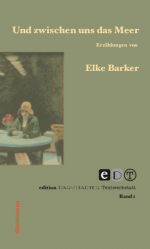
And between us the Sea
24 Short Stories
- Volume 1
- Edition Darmstädter Textwerkstatt
- Editor and Preface by
- Kurt Drawert
- 152 pages
- Hardcover with ribbon
- Comment by Martina Weber
978-3-86638-370-8
The volume brings together 24 short stories. Some of them were written in the Darmstädter Textwerkstatt.
Elke Barker writes short prose that consistently sets its very own movements of seeing, listening and speaking and imperceptibly shifts the reader's perceptive abilities on the few pages of its events—until we, together with the author, whirl into the funnel of an upheaval or, as if by chance, are deposited again in the familiar.—In his foreword, Kurt Drawert writes in his resourcefulness that shines as much in detail as in the whole:
»I don’t want to tell the story here because it would detract from being a metaphor. For the sea is only apparently the concrete topos used in this story; rather, in its symbolic meaning, it is the insurmountable rift that separates people from one another. This rift—I dare to highlight it as a central object of conflict for all narratives and to understand it paradigmatically—is irreversible like the human lack in and of itself. But this is not explicitly stated at all, because it is not evident to the narrator himself. He stands somewhere in the shadows of the studio into which that man with the unfamiliar name Aboud suddenly intrudes, and lays out the images and scenes before us like a rebus that we ourselves have to complete. This double connotation of serving lexical literalness and symbolic figure in equal measure, and leaving it to the reader to decide which form of reality to ascribe it to, is part of the stylistic method of the prose and gives it the aura of the ineffable.«
In addition to all this ineffable, indeed, at times uncanny, Martina Weber, who adds an additional location to the volume, emphasises this about Elke Barker's storytelling:
»She is open to what happens in her close surroundings, observes people, gets involved. Trust is unpredictable. Suddenly it shimmers, between strangers, and just as suddenly it has disappeared in a friendship. At times, elements of a dream logic flash up, creating irritation and depth. Even a non-place like a subway becomes unique, experiences magic. The tension lies above all in the atmosphere ...«
Both the editor and publisher would like to express their sincere thanks to the City of Darmstadt for kindly sponsoring!